
Do you need a way to enjoy your breaks that gives you a bit of a mental challenge? Associations – Colorwood Game from Burny Games is the answer.
Associations – Colorwood Game is the kind of word puzzle that looks easy right up until it isn’t. The first twenty boards feel approachable. The first time you’re three groups solved and the last four tiles make no obvious sense together, you realize the game is doing something genuinely clever.
These Associations Colorwood Game tips cover the thinking process that separates players who coast through early levels from ones who move through the hard boards without burning mistakes. Sign up for KashKick and those sessions can earn you real money through level milestones on top of the brain workout.
Why Play Associations – Colorwood Game?
Associations – Colorwood Game has passed 1.7 million downloads for reasons that go beyond novelty. It’s one of our favorite word puzzle app games. Here’s why you’ll love it too:
- It rewards the way you actually think. This isn’t about memorizing definitions or spelling words correctly. It’s about noticing patterns, making connections and thinking laterally. That’s a harder skill to put down once you’ve started.
- The difficulty scales intelligently. Early boards give you concrete, satisfying groups. By level 200 the game is asking you to group words by abstract shared properties or hidden letter patterns. The progression feels earned rather than arbitrary.
- It’s a legitimate brain workout. Research has shown that playing word games boosts your memory and focus, and generally improves your thinking. Associations – Colorwood Game delivers both in a low-pressure format.
- You get short sessions and a deep challenge. A single board takes minutes. A tricky one might make you set the phone down and come back with fresh eyes. Either way, you’re never committed to a long session unless you want to be.
- The earning angle is real. When you play with KashKick you can turn sessions into cash. Check out online games that pay you real money for the full picture.
How Associations – Colorwood Game Works
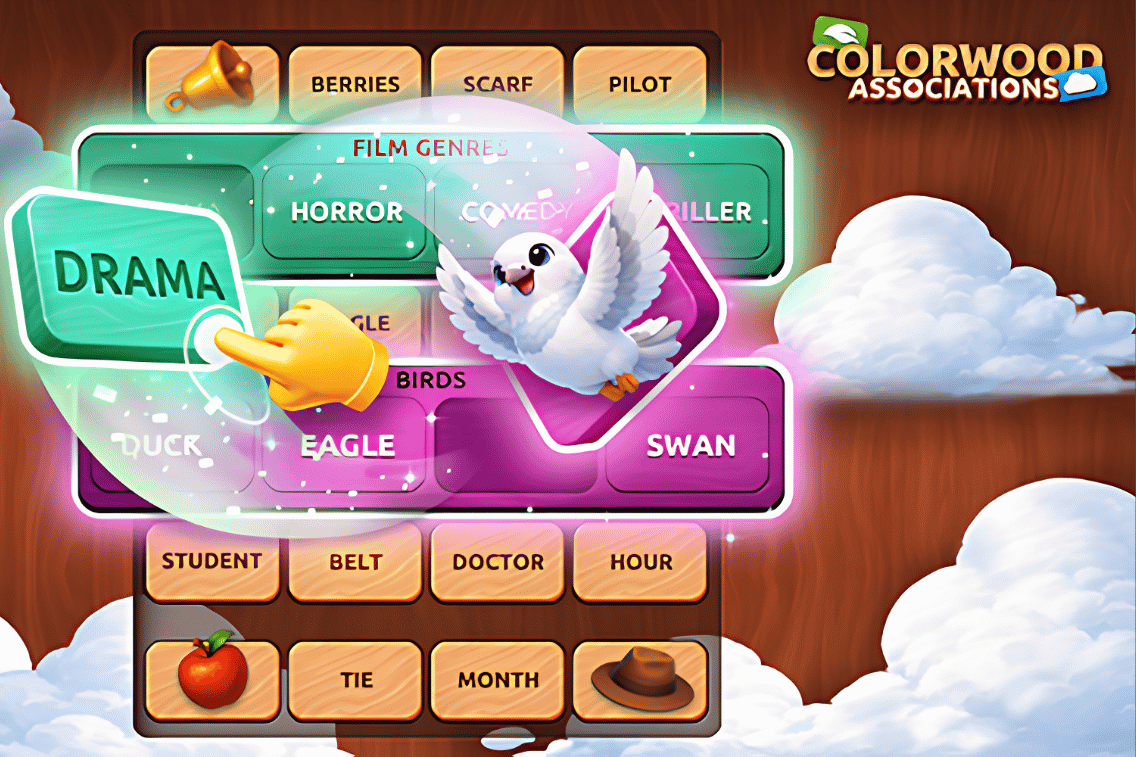
Each level gives you a board of wooden tiles, every one displaying a single word. Your job is to sort all the tiles into groups based on a shared connection. Here’s what that looks like in practice:
- The board. Most levels present 16 tiles that need to be sorted into four groups of four. The tiles clear from the board in their matching color once you identify the correct grouping.
- The connections vary by level. Early levels use concrete categories: animals, colors, kitchen items. Later levels use abstract properties (things that can be “broken”), compound word connections (words that precede “house”) or hidden letter patterns (“blueprint” contains blue).
- Mistakes matter. The game tracks incorrect guesses. Using your mistake allowance carelessly early in a board leaves you no room to experiment on the harder groups.
- The hint system. A hint costs coins and reveals the color group for one tile. Coins are earned through play or available for purchase.
- Daily challenge mode. One special puzzle per day, separate from main level progression, with bonus coins awarded for maintaining a streak.
Now for the moves that actually get you through the hard boards.
Tips to Step Up Your Associations – Colorwood Game
Our top tips will give you the edge and help you to level up fast.
1. Start with the group you’re most certain about
When a new board opens, resist the urge to immediately tap tiles. Scan the full board first and find the group you can place with the most confidence. Often that’s the most concrete or literal category: things you find in an office, types of weather, animals. Clearing that group reduces 16 tiles to 12, which makes every remaining connection easier to see. Fewer tiles means fewer false associations pulling your attention in the wrong direction.
2. Save the trick group for last every time
Almost every board from level 100 onward has at least one group built to mislead you. The words look like they belong to an obvious theme but actually share a different, less intuitive connection. Trying to crack the trick group head-on is where most mistakes happen.
The better move is to solve the three groups you understand first. The remaining four tiles form the trick group automatically. The process of elimination is more reliable than guessing at something designed to fool you.
3. Test compound word connections when you’re stuck
When a group feels elusive, shift your approach from meaning to structure. Pick a common connector word and ask whether it works with each tile. Can all four words follow “sun”? Can they all precede “yard”? Can they all follow “back”?
Compound word pattern testing is one of the most reliable unlock techniques for harder boards, particularly after level 150, where the game shifts from thematic categories toward structural and linguistic ones. It only takes a minute to run through a handful of candidates.
4. Ask what these words share, not which category they belong to
The most common mistake on hard boards is searching for a category label when the real connection is a shared property. Instead of “these must be a type of something,” ask “what do all of these words have in common that isn’t their type?”
The link might be a behavior, a physical property, or a semantic slot. Things that can be “broken” (record, heart, promise, glass). Things that can be “fast” (lane, food, break, car). That mental reframe catches dozens of boards that literal category thinking misses entirely.
5. Look for hidden letter and spelling patterns inside the words
Some boards group words not by meaning but by what’s hidden inside them. “Blueprint” contains blue. “Greenhouse” contains green. “Honest” contains the word “on.”
Scanning for embedded letter patterns is an advanced technique that many players discover late, usually when they’ve eliminated all other possibilities and the last group still doesn’t make sense. When meaning-based reasoning fails, read the shapes of the words themselves. Something structural is often hiding there.
6. Use hints as a last resort, not a first reaction
Hints cost coins and reveal the color group for exactly one tile. That’s useful but not definitive, since knowing one tile’s group still leaves most of the puzzle open. Save hints for boards where you’ve solved two groups, used one mistake and one specific tile is creating ambiguity across your two remaining groups.
Using a hint before you’ve attempted to reason through the board genuinely shortchanges the satisfaction the game is built around. Hints break deadlocks. They’re not a substitute for thinking.
7. Play the daily challenge to build your streak and coin supply
Beyond the main progression, Associations – Colorwood Game offers one fixed daily challenge puzzle with bonus coins for maintaining a consecutive-day streak. Daily challenge wins compound over time in a way sporadic single sessions don’t, and a larger coin supply means more hints available when you need them on harder boards.
If you’re working toward a KashKick mission, consistent daily play also moves you through level milestones faster than occasional binge sessions. Every daily challenge adds up.
Start Playing Associations – Colorwood Game for Real Rewards
Starting with your strongest group, saving the trick category for elimination, testing compound word connections, looking for abstract shared properties, scanning for hidden letter patterns, using hints precisely and showing up for the daily challenge are the habits that move you from stuck to solved on boards that would otherwise cost you all your mistakes.
Associations – Colorwood Game has over 1,000 levels and keeps adding more. Every board solved is a small move forward. If you want those moves to also put real money in your pocket, sign up for KashKick and start turning your puzzle sessions into actual rewards. For players already gaming on their phone, it’s exactly the kind of cash game app for iPhone that makes free time valuable. And if you want even more ways to stack, our guide for side hustle apps that pay is worth a look.
FAQs on Associations – Colorwood Game Tips
Can you get paid to play Associations – Colorwood Game?
Yes! With KashKick, you can turn your gameplay into real rewards. Here’s how:
- Make sure you haven’t played the game before (we only reward new users).
- Find your game in KashKick and review the mission details and requirements.
- Start the mission by installing the game through KashKick.
- Allow tracking on your device (and in the app, if prompted) so your progress can be verified.
- Complete outlined goals to earn rewards.
Heads up: Rewards are typically pending for around 14 days while they’re confirmed, but timing may vary. Once approved, you can cash out via PayPal, Venmo or KashRewards gift cards. Games are subject to change.
Is Associations – Colorwood Game free to play?
Yes. Associations – Colorwood Game is free to download. The game earns revenue through ads between levels and optional in-app purchases. Core gameplay including all levels and the daily challenge is fully accessible without spending anything.
How do hints work in Associations – Colorwood Game?
Each hint costs coins, which you earn through regular play or purchase in-app. When activated, a hint highlights the color group that one specific tile belongs to. This narrows down your options without giving away the full category. Hints work best when used after you’ve already cleared two groups and need to resolve which of two possible categories an ambiguous tile belongs to, rather than at the start of a board when you still have a full slate of options to reason through.
How is Associations – Colorwood Game different from NYT Connections?
Both games share the same core structure: sort 16 words into four groups of four. The key differences are scale and pacing. NYT Connections releases one puzzle per day, while Associations – Colorwood Game has over 1,000 levels that you play entirely at your own pace. Colorwood also adds a coin and hint economy, a daily challenge mode and the distinctive wooden tile aesthetic that gives the game its calm visual identity.
What is the daily challenge in Associations – Colorwood Game?
The daily challenge is a fixed puzzle that refreshes once per day, separate from the main level progression. Completing it contributes to a consecutive-day streak and awards bonus coins. Maintaining a streak over multiple days is the most efficient way to build your coin supply, which gives you more hints available when harder boards in the main progression require them.