
Do you love nothing better than a good dice game? Kismet: Dice Game is perfect for lovers of games like Yahtzee or Farkle. It’s your opportunity to challenge your friends, test your mettle in tournaments and enjoy earning achievements.
Kismet: Dice Game takes the familiar rhythm of Yahtzee-style dice rolling and adds a color layer that quietly changes every decision on the scorecard. The numbers matter. So do the colors. Miss the color angle entirely and you’re playing half the game while competitors clean up on flushes and same-color full houses you walked right past.
These Kismet tips cover the decisions that separate high scorers from players who fill the scorecard without ever finding the bonus tiers. You’ll learn how to manage the upper section with purpose, when the color system earns you significantly more points than the base version of a combination and why Yarborough is a resource to protect, not a consolation prize. And once you’ve sharpened your game, sign up for KashKick and let those tournament sessions earn real money on top of the leaderboard climbing.
Why Play Kismet: Dice Game?
FunCraft, Inc. is the San Francisco studio behind a catalog of sharp, competition-focused casual games, and Kismet is one of the more distinctive titles in that lineup. Here’s why it earns a spot in your rotation:
- It’s got a real strategic layer most dice games lack. The color system turns every roll into a two-dimensional decision. You’re not just chasing numbers; you’re weighing whether the color alignment makes a combination worth significantly more than its face value.
- It’s familiar enough to pick up in minutes. If you’ve played Yahtzee, Farkle or any Yacht-family dice game, the bones of Kismet are immediately comfortable. The colored pip mechanics are the part worth actually learning.
- There are multiple ways to play. Solo challenges, real-time PvP duels, global tournaments, Dice Masters competitions and a buddy system for playing friends all give you reasons to come back after the first session.
- It’s a game that rewards experience. The tiered upper section bonuses and the color-based lower section categories mean the more you understand the scoring system, the better your decisions become.
- You can earn by playing. Play through KashKick and your competitive Kismet sessions can earn real money while you climb the rankings.
How Kismet: Dice Game Works
The rules take five minutes to understand and a lot of rounds to genuinely master.
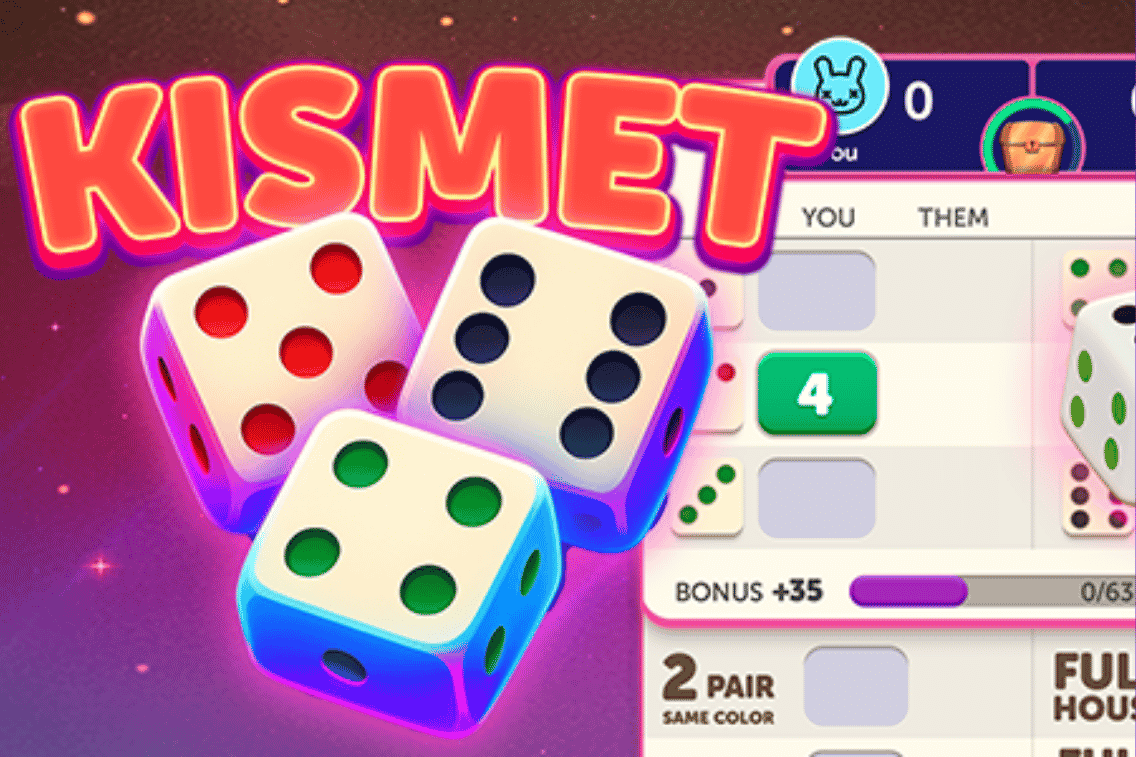
- The dice: Five dice with colored pips. Ones and sixes are black. Twos and fives are red. Threes and fours are green. Each color always pairs opposite faces on every die, which matters for the color-based categories below.
- A turn: Roll all five dice, hold any you want to keep, roll again, hold again, then roll a final time. After your third roll (or earlier if you’re happy with what you have), you must record a score in exactly one open category on the scorecard. Every category can only be filled once per game.
- The Basic Section (upper): Six categories for aces through sixes. Score only the matching dice. Higher totals here unlock tiered bonuses: 63 to 70 earns 35 bonus points, 71 to 77 earns 55 and 78 or more earns 75.
- The Kismet Section (lower): Color-aware combinations scored like poker hands. Two Pair Same Color, Three of a Kind, Straight, Flush, Full House, Full House Same Color, Four of a Kind, Kismet (five of a kind) and Yarborough are the nine categories here. Several add flat point bonuses on top of the sum of your dice.
- Kismet: Five dice showing the same number is the highest combination in the game. Score equals the total of all five dice plus 50 bonus points. A second Kismet in a multiplayer game forces every other player to record a zero in their next open Basic section category, which is a punishing swing.
- Yarborough: If your roll doesn’t qualify for any open category, Yarborough lets you score the plain sum of all five dice as a catch-all. Every player has one.
So, let’s move on to the strategy that will seriously up your game.
Tips to Step Up Your Kismet: Dice Game
1. Understand the color pairs before your first competitive match
The single most common beginner mistake in Kismet is treating it like Yahtzee with prettier dice. The colored pips are not cosmetic; they determine which combinations score higher and unlock unique categories entirely. Black is on 1 and 6, red on 2 and 5, green on 3 and 4. Knowing this off the top of your head means you can read a roll instantly and spot color opportunities without counting during your turn.
2. Load the upper section with high numbers
The Basic Section bonus tiers work in your favor if you push toward them deliberately. Scoring three fives (15 points) contributes more toward the 63-point threshold than three ones (3 points), for the same roll quality. When you have early turns available and a decent roll of high numbers, fill fours, fives and sixes first. Letting low-value categories drag down your upper section total is the most consistent way to miss the bonus thresholds entirely.
3. Always check if a roll qualifies for the same-color upgrade
Kismet rewards color alignment with significantly better scoring. A regular Full House scores the sum of your five dice plus 15. A Full House Same Color (three of one number and two of another, all showing the same color) scores considerably more. Before you automatically slot a combination into its basic category, check whether the color distribution qualifies for the same-color version. A roll of three greens and two greens, for example, qualifies for Full House Same Color regardless of the specific numbers, and misreading that costs you material points.
4. Treat Yarborough as a planned resource, not a panic button
Players who understand Kismet use Yarborough strategically. It exists specifically for turns where your three rolls produce nothing that fits an open category cleanly. Burning Yarborough in round two on a mediocre roll you could have absorbed into a lower-value category is a mistake that leaves you genuinely stuck later. Think of Yarborough as a life raft: you want it available for the turn where you truly have no good options, not spent early out of impatience.
5. Chase Flush and Straight only when the first roll is already close
Flush (all five dice showing the same color) scores 35 fixed points. Straight (five consecutive numbers) scores 30 fixed points. Both are high-value but low-probability categories that require exact conditions. The right play is to hold toward them only when your first roll already shows three or four dice satisfying the requirement. Starting a reroll sequence from scratch to chase a Flush rarely pays off compared to taking a solid Three of a Kind or Four of a Kind with the same dice.
6. In multiplayer, keep your Basic section well-stocked against the second Kismet
The second-Kismet penalty in multiplayer is one of the more punishing swings in casual dice gaming: an opponent rolling five of a kind a second time forces you to take a zero in your next open Basic section category. A player who has already filled most of their Basic section absorbs this penalty with much less damage than one who left those categories open. Completing your upper section at a reasonable pace protects you. Players who delay the Basic section to chase lower-section combinations leave themselves exposed.
7. Know when Four of a Kind beats chasing Kismet
Five of a kind is the peak combination, but the probability of converting four-of-a-kind dice into five on a single reroll is low. Four of a Kind already scores the sum of all five dice plus 25 bonus points, which is substantial. If you have four matching dice after roll two, accept the Four of a Kind rather than gambling the guaranteed bonus on a Kismet reroll. The expected value of holding four and re-rolling one rarely exceeds taking the four-of-a-kind score, especially when your Kismet box is already filled.
8. Keep a mental note of which lower-section categories are still open
Experienced Kismet players make efficient decisions because they always know which of their nine Kismet Section categories have been filled. A roll that seems like it should go into Three of a Kind might be better used for Yarborough or Two Pair Same Color depending on what’s still open. Losing track of your own scorecard mid-game leads to wasted turns and late-game zeros in categories you needed. A quick mental review before committing each roll is the simplest habit separating consistent scorers from players who scramble at the end.
Turn Kismet: Dice Game Time Into Rewards
Kismet: Dice Game gives you a tournament and challenge structure built for players who want to compete and keep improving. Running those sessions through KashKick adds real money to every mission you complete along the way. While you’re navigating the color system and optimizing your bonus tier approach, KashKick tracks your progress and pays out real rewards for hitting the game’s goals.
Every session is a small, strategic move in the right direction. That’s Kismet’s whole appeal and it’s exactly what earning while you game looks like in practice. iPhone players can find a full library of cash game apps for iPhone to keep earning between Kismet sessions, and anyone looking to stack more into a daily routine will find plenty more in KashKick’s side hustle apps that pay.
FAQs on Kismet: Dice Game Tips
Can you get paid to play Kismet: Dice Game?
Yes! With KashKick, you can turn your gameplay into real rewards. Here’s how:
- Make sure you haven’t played the game before (we only reward new users).
- Find your game in KashKick and review the mission details and requirements.
- Start the mission by installing the game through KashKick.
- Allow tracking on your device (and in the app, if prompted) so your progress can be verified.
- Complete outlined goals to earn rewards.
Heads up: Rewards are typically pending for around 14 days while they’re confirmed, but timing may vary. Once approved, you can cash out via PayPal, Venmo or gift cards. Games are subject to change.
How are the dice colored in Kismet: Dice Game?
The five Kismet dice have colored pips based on number value: ones and sixes are black, twos and fives are red, and threes and fours are green. Each color pairs two opposite faces on every die. This design creates the color-based scoring categories that distinguish Kismet from standard Yahtzee-style play.
What is the Yarborough category in Kismet: Dice Game?
Yarborough is a catch-all scoring category in the Kismet Section. When your final roll doesn’t qualify for any other open category, you can enter the plain sum of all five dice into Yarborough. Each player has one Yarborough available per game. Experienced players hold it for turns where they genuinely have no better options rather than spending it on early mediocre rolls.
What happens when you roll a second Kismet in multiplayer mode in Kismet: Dice Game?
After a player has already scored their first five-of-a-kind, any subsequent Kismet in the same game triggers a penalty for all other players: each opponent must record a zero in their next open Basic section category and forfeit that turn. The player who rolled the second Kismet then takes an extra turn immediately. This rule makes Kismet one of the most impactful individual rolls in any casual dice game.
Is Kismet: Dice Game free to play?
Yes. Kismet is free to download on both iOS and Android. It includes optional in-app purchases for ad removal and cosmetic dice designs. The full game, including tournaments and PvP modes, is accessible without spending anything.
Start Playing Kismet: Dice Game for Rewards
Knowing the color pairs, loading the upper section with high numbers, recognizing same-color upgrades before committing rolls, protecting Yarborough for when you truly need it and keeping the Basic section filled against multiplayer penalties are the habits that push Kismet scores from average to consistent.
Sign up for KashKick and give your free time a raise while you roll. Your Kismet: Dice Game sessions can earn real rewards; all it takes is playing smart.