
Do you want to show off your card skills? Card Connect: Make Sequences is your opportunity to do just that. Outwit your fellow players, climb the leaderboard and engage your mind with this funky take on the traditional Sequences game.
Winning at Card Connect: Make Sequences isn’t about drawing the best hand. It’s about reading the board two moves ahead while your opponent is still deciding on one. The players who climb the league rankings consistently aren’t the lucky ones; they’re the ones who know exactly when to play a Jack, which spaces carry the most strategic weight and how to build toward two sequences at once without telegraphing either of them.
These Card Connect tips cover all of that: the Jack mechanics that catch beginners off guard, the board positions worth fighting for and the habits that separate consistent winners from players who plateau mid-league. And if you want your competitive sessions to earn something beyond trophies, sign up for KashKick and turn your gameplay into real money while you climb.
Why Play Card Connect: Make Sequences?
FunCraft has built a catalog of sharp, strategy-focused mobile games and Card Connect fits squarely in that lineage. It takes the beloved Sequence board game concept and sharpens it into something built for competitive mobile play. Here’s what makes it worth your time:
- It’s got pure strategic depth. Every decision is meaningful: which space to claim, whether to hold a Jack and when to disrupt your opponent’s build. Luck is part of the draw but skill drives results over time.
- You can enjoy fast, intense PvP rounds. Head-to-head duels resolve quickly and the real-time format keeps pressure on every turn. It’s the right pace for competitive play without the fatigue of a marathon session.
- There’s a live progression system. Leagues, rankings, Duel Journey Mode and achievements give you goals that build on each other, so there’s always a reason to play one more match.
- It’s accessible but not shallow. New players pick it up in minutes. Experienced players spend weeks learning the deeper positioning and Jack-timing strategies that actually win matches at higher leagues.
- You can earn for playing. Stack the competitive satisfaction of climbing Card Connect’s leagues with real money through KashKick and every duel does double duty.
How Card Connect: Make Sequences Works
Card Connect is inspired by the classic board game Sequence, with a digital PvP twist. Here’s what you need to know:
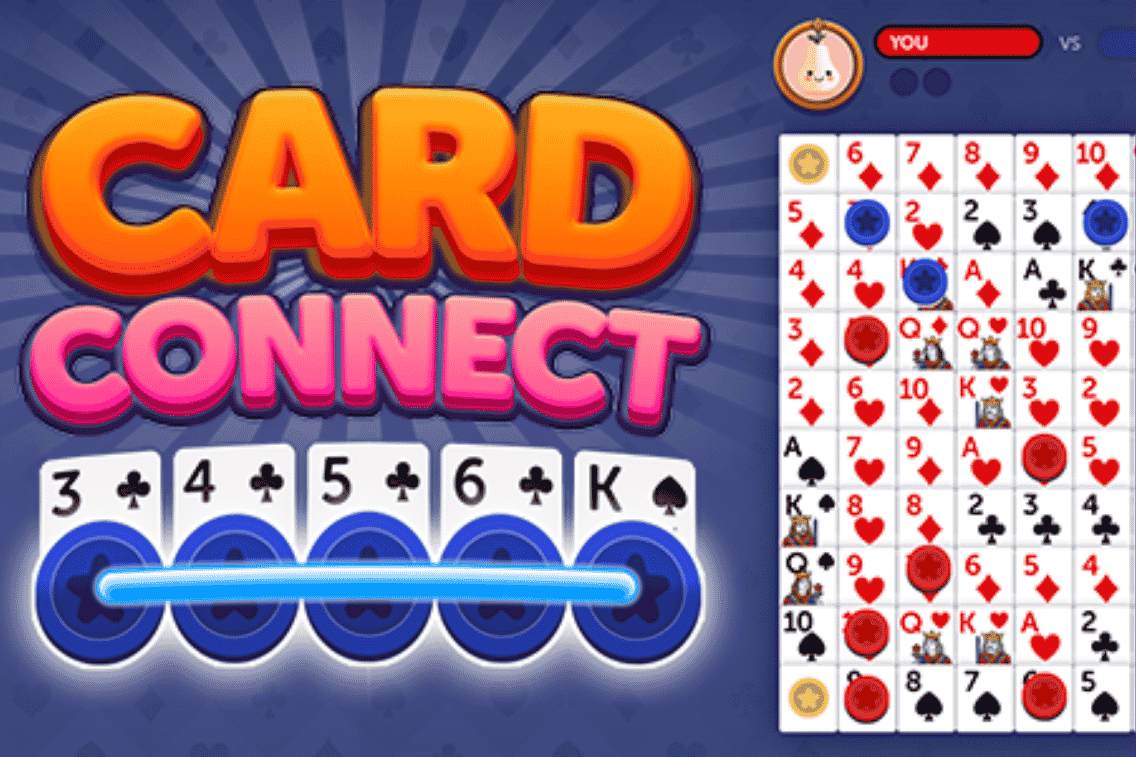
- The board: A grid of spaces, each displaying a card value. Every card in the deck appears on two spaces. Jacks have no board spaces of their own because they work differently from every other card.
- Your turn: Play a card from your hand, place your chip on one of its two matching board spaces, then draw a replacement card. Simple on the surface; the complexity comes from which of the two spaces you choose and why.
- Sequences: Form a connected row of five of your chips, horizontally, vertically or diagonally, to score a sequence. In Card Connect’s PvP format, forming sequences before your opponent wins the duel.
- Corner spaces: Each corner of the board is a free wild space any player can use. A sequence that runs through a corner only requires four of your chips, not five, making corners extremely high-value real estate.
- Two-Eyed Jacks (wild): Play one to place your chip on any open space on the board, regardless of what card that space displays. The most powerful offensive tool in the game.
- One-Eyed Jacks (anti-wild): Play one to remove a single opponent chip from the board. The chip must not be part of a completed sequence. A completed sequence cannot be broken. This is the game’s primary disruption mechanic.
- Dead cards: When both board spaces for a card in your hand are already claimed, that card becomes a dead card. On your turn, discard it and draw a fresh replacement before taking your normal move.
Now you understand the mechanics of the game, let’s find out how to play to win.
Card Connect: Make Sequences Strategies That Actually Work
Every tip below targets a specific decision or habit that separates strong Card Connect players from players who stall out in the early leagues.
1. Save Two-Eyed Jacks for sequence completion or critical blocks
Two-Eyed Jacks are the most powerful cards in the game and the most wasted by beginners. Playing one in the early game to claim a convenient space throws away the move that could close a winning sequence or deny your opponent theirs in the final turns. Hold Two-Eyed Jacks until you need to complete a sequence you cannot reach otherwise, or until your opponent is one chip away from winning. At that point, a well-placed Jack either wins you the duel or buys you the turns needed to finish your own sequence.
2. Use One-Eyed Jacks on the chip closest to completing your opponent’s sequence
One-Eyed Jacks remove opponent chips, but most beginners pull a chip at random. The correct play is surgical. Identify your opponent’s longest connected chain and remove the chip that either breaks that chain or forces them to rebuild from a shorter run. Removing an isolated chip in an unimportant position accomplishes almost nothing. Removing the fourth chip in a row that needed one more to win buys you several turns of runway.
3. Fight for corner spaces early
Corner spaces are the most efficient positions on the board because they count as free chips for any sequence running through them. A sequence built through a corner only needs four of your chips instead of five, which means you need one fewer card to close it. In a PvP duel where every turn is contested, saving a move is a meaningful advantage. When a corner-adjacent space appears in your hand early, prioritize it. Opponents who understand corners will do the same.
4. Build toward two sequences at the same time
A player building toward a single sequence is easy to stop: one well-timed One-Eyed Jack or a single block placement can stall you for several turns. Building toward two separate sequences simultaneously means your opponent has to block both or surrender one, and in most hands they can only commit to one disruption path at a time. Spread your early chip placements across two distinct rows or diagonals and keep both threats alive rather than going all-in on one sequence that your opponent can clearly see coming.
5. Claim spaces that serve two potential sequences
When you have a choice between two board spaces for the same card, choose the one that contributes to the most possible future sequences. A chip placed at the intersection of a horizontal row and a diagonal is twice as valuable as one at the end of a single line. Experienced Card Connect players constantly ask: “Does this space feed into one potential sequence or two?” The answer to that question determines where they play, not just which space happens to be available.
6. Exchange dead cards immediately without hesitation
When a card in your hand is dead (both board spaces already occupied), there’s no strategic reason to hold it. Discard it on your next turn and draw a fresh card without delay. A dead card in your hand is a lost turn slot: it takes up space that a playable card could fill. Some beginners hold dead cards out of habit or indecision. Clearing them immediately keeps your hand as flexible and dangerous as possible throughout the duel.
7. Don’t build your winning sequence in one obvious direction
Experienced opponents read board patterns fast. If every chip you place is clearly extending the same visible row, they’ll block it before you can close it. Build in ways that leave your final sequence ambiguous until the last possible move, placing chips that could believably belong to multiple directions. When your opponent can’t be certain which line you’re going for, they’re forced into guessing rather than blocking with precision. That uncertainty is one of the most consistent advantages in high-league Card Connect play.
Turn Card Connect: Make Sequences Time Into Rewards
Card Connect: Make Sequences is already built for players who want to compete and improve. Pairing it with KashKick adds real money to every mission you complete. While you’re climbing leagues and working through Duel Journey Mode, KashKick tracks your progress and pays out real rewards when you hit the goals.
Think of it as a micro power move: you’re already investing the time to sharpen your strategy. You may as well make money playing games while you do it. iPhone players can also explore a full library of cash game apps for iPhone to stack more earning opportunities alongside Card Connect sessions. For players looking to expand further, KashKick’s lineup of side hustle apps that pay has options well beyond card games.
FAQs on Card Connect Make Sequences Tips
Can you get paid to play Card Connect: Make Sequences?
Yes! With KashKick, you can turn your gameplay into real rewards. Here’s how:
- Make sure you haven’t played the game before (we only reward new users).
- Find your game in KashKick and review the mission details and requirements.
- Start the mission by installing the game through KashKick.
- Allow tracking on your device (and in the app, if prompted) so your progress can be verified.
- Complete outlined goals to earn rewards.
Heads up: Rewards are typically pending for around 14 days while they’re confirmed, but timing may vary. Once approved, you can cash out via PayPal, Venmo or gift cards. Games are subject to change.
What is the difference between a Two-Eyed and One-Eyed Jack in Card Connect: Make Sequences?
Two-Eyed Jacks are wild cards that let you place your chip on any open space on the board, regardless of what card is displayed there. One-Eyed Jacks are anti-wild cards that let you remove a single opponent chip from the board. The key restriction: you cannot remove a chip that is part of a completed sequence. Understanding which Jack you’re holding and when to deploy each one is the most important skill in Card Connect.
What is a dead card in Card Connect: Make Sequences?
A dead card is any card in your hand where both of its matching board spaces are already occupied by chips. Since you cannot play a dead card normally, you can discard it on your turn and draw a replacement card before making your standard move. Always exchange dead cards immediately so your hand stays full of playable options.
What is Duel Journey Mode in Card Connect: Make Sequences?
What is Duel Journey Mode in Card Connect: Make Sequences?
Is Card Connect: Make Sequences free to play?
Yes. Card Connect: Make Sequences is free to download on both iOS and Android.
Level Up Your Card Connect: Make Sequences Game
Holding Two-Eyed Jacks for decisive moments, targeting the opponent’s longest chain with One-Eyed Jacks, fighting for corner spaces early, building toward two sequences simultaneously, choosing spaces that feed multiple directions and clearing dead cards without delay are the habits that separate consistent Card Connect winners from players who plateau in the early leagues.
Every duel is a calculated move. Sign up for KashKick and give your free time a raise while you work through the ranks. Your Card Connect sessions can earn real rewards; all it takes is playing smart.